
7 min readBy Marcel Sattler
Hire a Native Ads Agency vs. DIY: 3 Reasons in 2026
Native ads punish DIY launches because there's no smart algorithm to bail you out. Here are the three places beginners burn money, and why an agency setup wins on the same budget.
From the post
You can teach almost anyone to launch a Meta campaign from scratch.
, Marcel Sattler
↓ read on
You can teach almost anyone to launch a Meta campaign from scratch. Sit them in front of a computer, point them at a few free YouTube videos, give them decent creatives, and the algorithm does the rest. Native ads do not work that way. There is no smart, interest-based algorithm carrying you across the finish line, and that single difference is where most self-taught buyers lose thousands of dollars before they ever see a profitable campaign.
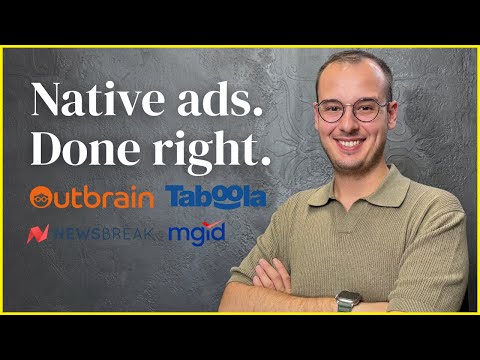
I'm Marcel Sattler, founder of native-advertising.net, and since 2015 I've deployed more than $100M across Taboola, Outbrain, Newsbreak, MGID, Yahoo Native, Mediago, and RevContent for DTC, lead-gen, and affiliate advertisers. I'll be blunt about my bias up front: I run an agency, so my view isn't neutral. But the reason I'm making this case is the steady stream of people who tried native themselves first, got burned, and only then came to us. After a decade of cleaning up those accounts, the pattern is the same three failures every time.
Why native ads punish DIY launches more than Meta or Google
The big native traffic sources, Taboola, Outbrain, MGID, RevContent, have algorithms, but they are nowhere near as smart as Meta's or Google's. Those companies are far larger, and they've poured far more into auto-targeting and optimization. On Meta, interest-based targeting does a lot of the heavy lifting for you. On native, the platform hands you a much rougher tool and expects you to bring the know-how.
That's the trap. When you start native cold and "try it a bit by yourself," you don't just underperform, you lose more money than a professional agency setup would have cost you in the first place. The economics are inverted from what most buyers expect, and I'll show you exactly where the cash leaks out.
One more thing before the three reasons: don't start with native at all if you're brand new to paid media. Get profitable on Meta, Google, or YouTube first. Those are faster, easier wins. Native is the next step, not the first one. If you want a vertical-specific starting point, see /solutions/ecommerce for DTC and dropship or /solutions/lead-gen for lead-gen.
Reason 1: Experience starts at conception, not at launch
The first reason is experience, and it bites before you ever upload an ad. If you're coming from Meta or Google, your instinct is to copy and paste what worked there. Native is a different game, it runs under the radar, where people don't realize they're being advertised to, and that's exactly why it's so powerful. Treat it like a Facebook campaign and you'll pay for the lesson.
Here are the three conception mistakes I see most often:
- One marketing angle. You sell a weight-loss product, so you run "here's how you can lose weight" and stop there. You never test "this doctor in the US recommends ABC" or "I'm John, I lost 8 pounds a week with this." Native lives and dies on angle testing.
- One advertorial, no split tests. Changing a single headline or call-to-action can take your advertorial CTR from 5 or 6% to 12 or 15%, a doubling, from one simple A/B test. Skip the testing and you leave that lift on the table.
- Branded funnel structure. People write a weak advertorial and host it on their own domain, so it reads as a branded ad instead of external editorial. Readers feel sold to, the "native" effect collapses, and conversions drop.
Every one of these requires reading your KPIs and making data-driven decisions, not guessing. That's what experience buys you, and it's why our in-house copywriters and conversion experts exist. See how we structure that on /solutions/affiliates for affiliate offers.
Reason 2: Media buying is where accounts quietly die
The second reason is the media buying itself, and it doesn't matter whether you're on Taboola, Outbrain, MGID, or RevContent, each platform is handled differently. Even if you think you've mastered one, "well enough" is hard: there are multiple campaign types, device types to separate, and offers to isolate. This is the single biggest place to bleed money, and three mistakes do most of the damage.
Choosing the wrong campaign type
Platforms offer different campaign types, conversion-max, target CPA, and others. Pick the wrong one at the start and you can destroy a brand-new native account permanently. You train the pixel the wrong way, and from that point the data from your publishers and your ads is useless. There's no clean recovery; you've corrupted the learning the account is built on.
Putting all devices in one campaign
In native you separate devices: one campaign for mobile, one for tablet, one for desktop. Bids differ, conversion rates differ, and you often need a different funnel per device. Dump everything into a single campaign and your bid gets dragged high enough to win every auction, but only on mobile. You win the auction and lose the money.
Running without a block list
A brand-new Taboola account shows your ads across nearly every publisher in the network. Taboola has premium publishers and cheap ones, the cheap inventory is "push traffic," often in-app placements like the "click here to continue" prompts you see inside mobile games. Those publishers post huge CTRs and convert at nothing. They cost money and return zero. Fixing it requires a rep and a properly configured block list. Without one, an agency will outperform you on an identical setup, purely on the block list. We do this daily as a /taboola-agency and /outbrain-agency, and the same logic carries to /mgid-agency and /revcontent-agency.
Reason 3: Misreading KPIs makes optimization impossible
The third reason is KPIs, either misreading them or not measuring them at all. Native runs a longer funnel than Meta, and you have to measure every step. The traffic source tracks your ad CTR for you. But the advertorial CTR for each A/B/C/D variant, which advertorial produces the cheapest sales in e-commerce, which produces the most qualified leads, not the cheapest leads, the most qualified, that's on you. Most DIY buyers either skip this entirely or read the data wrong, and without it, optimizing the funnel is almost impossible.
This is also where native's cost curve confuses people, because it runs the opposite of Meta. On Meta, a new ad starts cheap with good sales and leads, then the CPA climbs the moment you try to scale. On native, you start expensive with a broad funnel and get cheaper as you optimize.
Here's the sequence we run to narrow that funnel:
- Launch broad with multiple angles, then cut the angles that aren't working.
- Narrow by creative, kill what fails (illustrations dead, plain product shots dead) and keep what converts (portraits working).
- Narrow by advertorial, find the winner (a user story in an amateur-style layout) and concentrate spend there.
Each cut tightens the funnel and drops the cost. After a couple of days or weeks, depending on budget, the account turns profitable, but only if you measured well enough to know which pieces to keep. You can see what the optimized end state looks like across verticals on /case-studies.
Freelancer vs. agency: what you're actually paying for
You don't strictly need an expensive agency, you can hire a freelancer or a media buyer on Fiverr or Upwork. I have nothing against those platforms. But a genuinely good marketer rarely sells on them, because a good marketer doesn't have to offer services at a rock-bottom price. When you hire us, we're expensive, and the reason is simple: we deliver results.
That price buys experience and a full workforce, copywriters, web designers, conversion experts, and data analysts, all in house. It's close to an insurance policy that your campaigns get profitable fast. You're not buying the cheapest rate; you're buying the best bang for your buck because it actually works.
Even a freelancer who's genuinely good at Taboola or Outbrain usually can't build the whole concept, the angle strategy, the advertorials, the copy. We staff native speakers who write in the mother language of the country we're advertising in, with marketing and psychological backgrounds, paid to research until they know the exact pain points and trigger points that make an advertorial convert. That research is a real part of the secret sauce.
Watch the full breakdown
Where to go from here
If you're already profitable on Meta, Google, or another platform, native is a strong next step, not a starting point. The mistakes above are predictable and expensive, and every one of them is avoidable with the right setup from day one. The question isn't whether you can learn native; it's whether you want to fund the tuition with a destroyed pixel and a month of push traffic.
If you'd rather skip the burn, book a strategy call at /contact and we'll tell you honestly whether your account and offer are a fit. You can also browse more breakdowns at /resources or review real outcomes on /case-studies.
▸ Keep reading
Three more on the same topic.
Native ads
▸ From the video
8 min read
The First 30 Days With a Native Ads Agency: What to Expect (2026)
Read article
Native ads
▸ From the video
6 min read
Programmatic vs. Classic Native Ads: Which One to Use (2026)
Read article
Native ads
▸ From the video
7 min read
VSL vs. Advertorial for Native Ads: When to Use Each (2026)
Read article