Native ads for e-commerce brands that already win on Meta
You found a product that sells and an offer that converts, and every extra dollar on Meta now buys less than the one before. We add native traffic next to Meta, so your store gets a second source of new customers that answers to its own auction.
Sound familiar?
ROAS ↓
You raise the budget on Meta. ROAS drops. You pull back, and you are where you started.
Restricted
Your ad account gets restricted. Campaigns stop, and you wait for a review.
Copied
Your best ad shows up in a competitor's feed a few weeks after it started working.
If two of these hit home, take the 60-second fit check.
The Meta ceiling is real, and more budget does not move it
You know the pattern. The account runs well at one spend level. You push the budget and ROAS slides. You pull back, it recovers. Weeks later you try again and the same thing happens. Meanwhile your best ads show up in the Ad Library for every competitor to copy, and one policy flag can freeze the account you built the business on.
That usually means you have bought most of the cheap attention one platform can sell you.
Native ads put your product in front of people reading articles on news and content sites, through networks like Taboola and Outbrain. Different readers, different auction, different creative rules. When it works, it adds revenue on top of Meta. It does not replace it.
Signs you are at this point:
- Meta is profitable, but each budget increase drags ROAS down
- Your account or ads keep getting restricted, and every restriction costs you days
- Competitors copy your winning creative within weeks
- Your post-purchase flow is solid, and the bottleneck is new customers at the top
Who this is for
Native takes work before it pays, so we would rather say no early than burn your budget.
A good fit:
- You already spend about $1k a day or more on Meta, and you are profitable there
- Your average order value is $60 or higher
- E-commerce first: DTC brands, Shopify stores and dropshippers with a proven product
- You can wait a few weeks for test data before you judge the channel
Not a fit yet:
- The offer has never sold anywhere. Native is for scaling a product that already sells
- You need positive ROAS in week one
- Your total ad spend is under $500 a day. The course is the better start, and you can run it yourself
- Your post-purchase flow is leaking. Fix refunds, fulfilment and email first, then add traffic
The fit check takes about 60 seconds. If there is a good fit, you pick a time with Marcel.

“If you're scaling your e-commerce offer on Meta, sooner or later you're gonna hit an invisible ceiling.”
What a native funnel for a store looks like
Native readers are not shopping. They clicked a headline while reading something else, so a product page wastes most of the click. The funnel has three parts:
- The ad. A headline and image in a recommendation widget on a publisher site. Its only job is to earn the click from someone who was not looking for you.
- The advertorial. An article, blog post or listicle that tells the story, names the problem, and makes the case for your product. On networks like Taboola and Outbrain, a page like this has to be labelled as an advertisement at the top. We build that in from the start.
- The offer page. Built for a reader who just finished an article. Price, bundle, guarantee and proof, in the order that reader needs them.
How long the advertorial runs depends on how aware the reader is. Someone who already knows the problem needs a short page and proof. Someone who has never thought about it needs a story first. In Case 01 we built three separate funnels for cold, warm and hot readers on the same hero product.
Could native work for your brand?
Check your fit · 60 secHow we work with your brand
Everything is in your name from day one. Ad accounts, pixels, advertorials and data belong to you. If we ever part ways, you keep the whole setup.
The kill rule is written down before launch. We agree in writing when a test gets switched off. No arguing about it in week four.
You talk to Marcel directly. No account manager relaying messages.
Tracking is server-side. Native networks need clean purchase signals to bid well, and browser pixels miss too many orders. We set up server-side tracking so the network and your Shopify numbers can be compared.
Two documents you get in week one.
No vague promises. You see when a test stops and how we count profit, in writing.
Kill rule
Contribution per day
Before agency fee and overhead. One number on the weekly call: if it does not grow, budget does not grow.
Your first 90 days
Weeks 1 to 2: Build. Tracking, angle research, advertorials and offer pages. Nothing goes live before purchases are recorded correctly.
Weeks 3 to 5: Test. Up to 81 combinations of angle, headline, advertorial and offer. Three of each, crossed, so we learn which piece wins and why.
Weeks 6 to 12: Scale. Budget goes only into winners. One weekly call. One number we report on: profit per day.
Two stores, two ways native added revenue
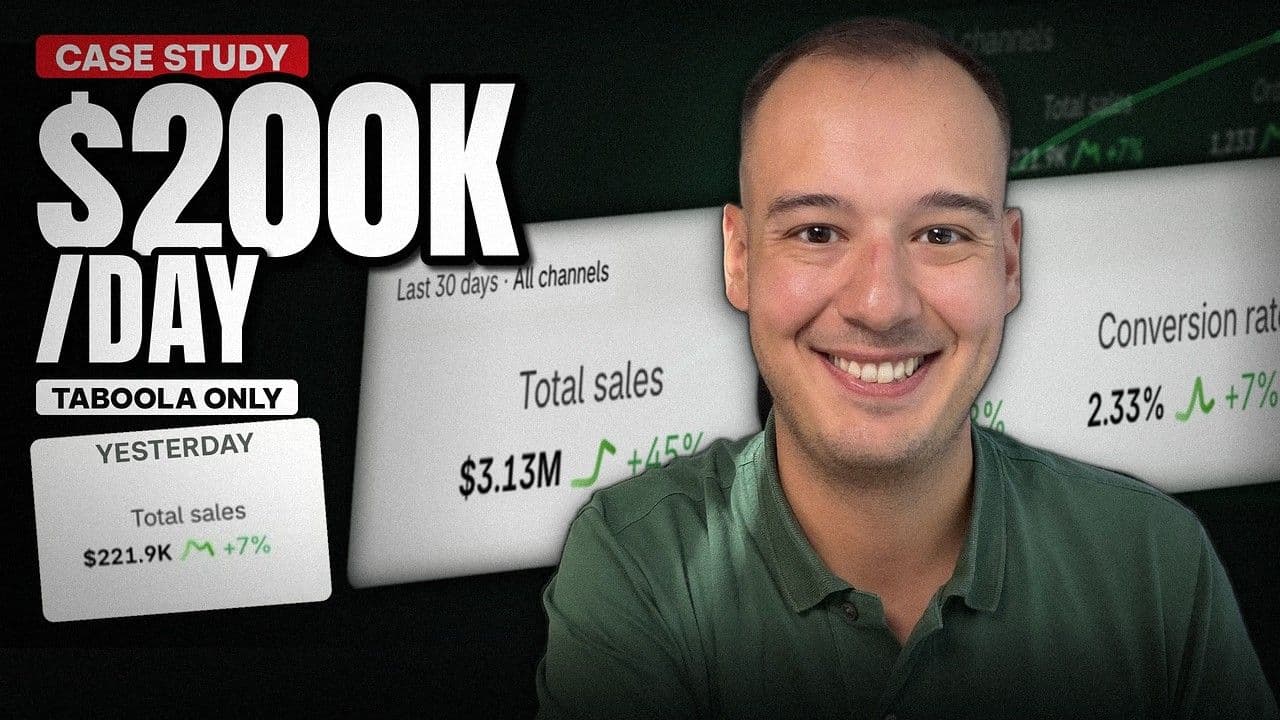
Case 01: one hero product on Taboola The brand was making about $5K a day in spring. The ad account kept getting restricted, and competitors copied its ads from the Ad Library. We started on Taboola in May 2026 and sent all traffic to one hero product instead of the full catalogue. Since then we have tested 56 angles and 347 advertorials, with three funnels for cold, warm and hot readers. In the last 30 days the store did $3.11M in Shopify sales. Watch Case 01
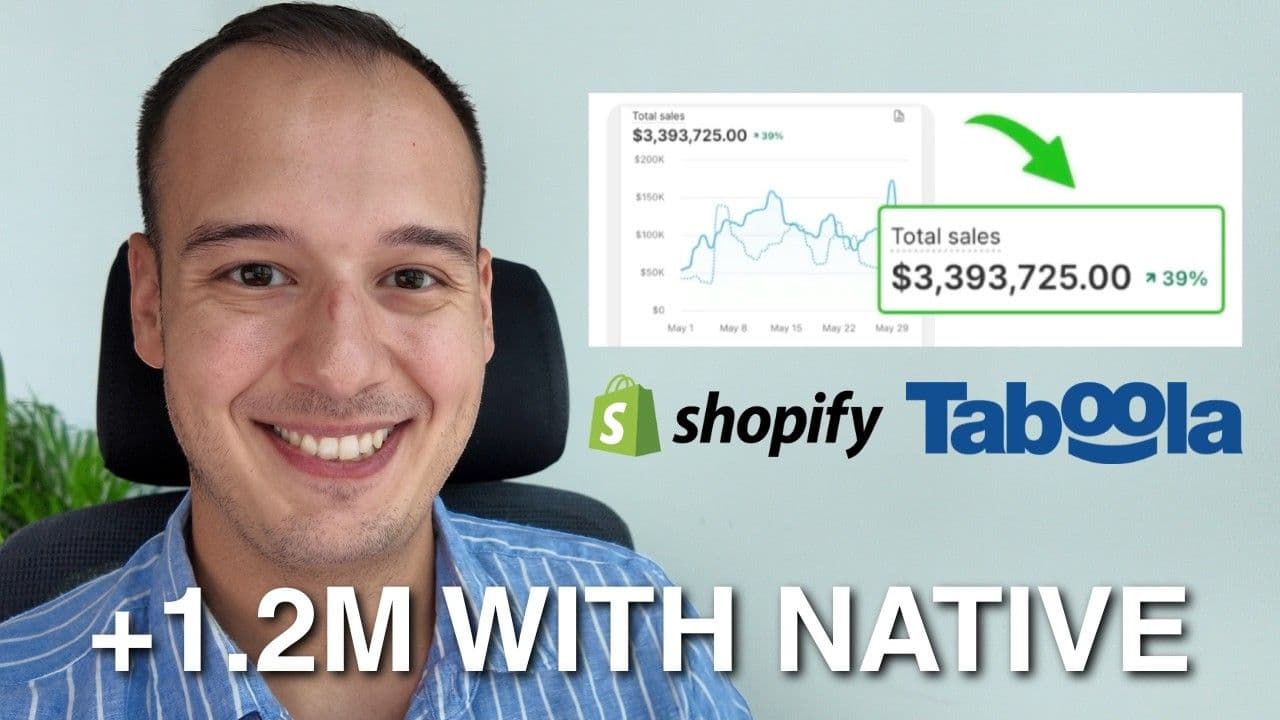
Case 02: native next to a profitable Meta account This store was profitable on Meta and stuck at $2.3M. Every push on budget cost ROAS. We added Taboola and kept Meta running. The product is evergreen, so no seasonal tailwind. We tested three angles, each with three advertorials: a newspaper-style article, a first-person blog post and a listicle. Angle three won, in under two weeks. 90 days later the store stood at $3.4M. Marcel says it plainly in the video: one account, one vertical, and the fast end of what we see. Plenty of stores take longer. Watch Case 02
Brand names stay private. Both cases are on video with the Shopify numbers on screen.
Which networks we use for stores
Both case studies on this page ran on Taboola. Outbrain and NewsBreak come in when the first network is profitable and you want more volume. We pick the network for your product and market on the fit call.
Dropshipping store? There is a separate page on native ads for dropshipping.
Frequently asked questions
Do native ads work for e-commerce?
Yes, for stores that already have a proven product and a working offer. Native readers are cold and in reading mode, so the product needs an advertorial that tells its story before the sale. Stores that are profitable on Meta at $1k or more a day with an AOV of $60 or higher are the ones we take on, because the offer has already been tested.
Will native ads replace Meta?
No. In Case 02, Meta kept running while Taboola was added. Native adds a second source of new customers with its own auction and its own audience. If Meta stays profitable, keep it. The goal is more total profit per day, and a store that does not depend on one ad account.
How long until native ads are profitable?
It depends on the product and the funnel. Our 90-day plan spends weeks 1 to 2 on build and weeks 3 to 5 on testing before any scaling. In Case 02 a winner showed up in under two weeks, which Marcel calls the fast end. Many stores take longer. If you need ROAS in week one, native is the wrong channel.
What is an advertorial and why do I need one?
An advertorial is a page written like an article that sells a product. Native readers clicked from a news site, so a product page feels abrupt to them. The advertorial gives them the story, the problem and the reason to buy. Networks like Taboola and Outbrain require it to be labelled as an advertisement at the top.
What AOV do I need for native ads?
We look for $60 or more. Native clicks are cold and the funnel is longer than on Meta, so a low-priced product rarely leaves enough margin per order to pay for testing. Bundles and upsells can lift a lower AOV into range. If yours is close, mention it in the fit check.
Who owns the ad accounts and creatives?
You do. Ad accounts, pixels, advertorials and data are set up in your company's name from day one, not in ours. If we stop working together, you keep everything we built: the network accounts with their history, the tracking setup and every advertorial and offer page. Nothing has to be handed back or rebuilt.
What if I spend less than $1k a day on Meta?
Under about $500 a day in total spend, the course at native-ads-course.com is the better choice. It shows you how to build angles and advertorials yourself. Between those two numbers, take the 60-second fit check. If there is a good fit, you pick a time with Marcel and talk through which route makes sense.
Find out in a minute if native fits your store
Three questions, 60 seconds. Good fit? You pick a 60-minute call with Marcel on the spot.