Taboola case study: from Meta restrictions to $3.11M in Shopify sales in 30 days
In spring this skincare brand made about $5K a day and kept losing its Meta account. We moved it to Taboola in May 2026, and the Shopify dashboard in this video shows $3.11M in sales for the last 30 days.
- Category: skincare, one hero product
- Start on Taboola: May 2026
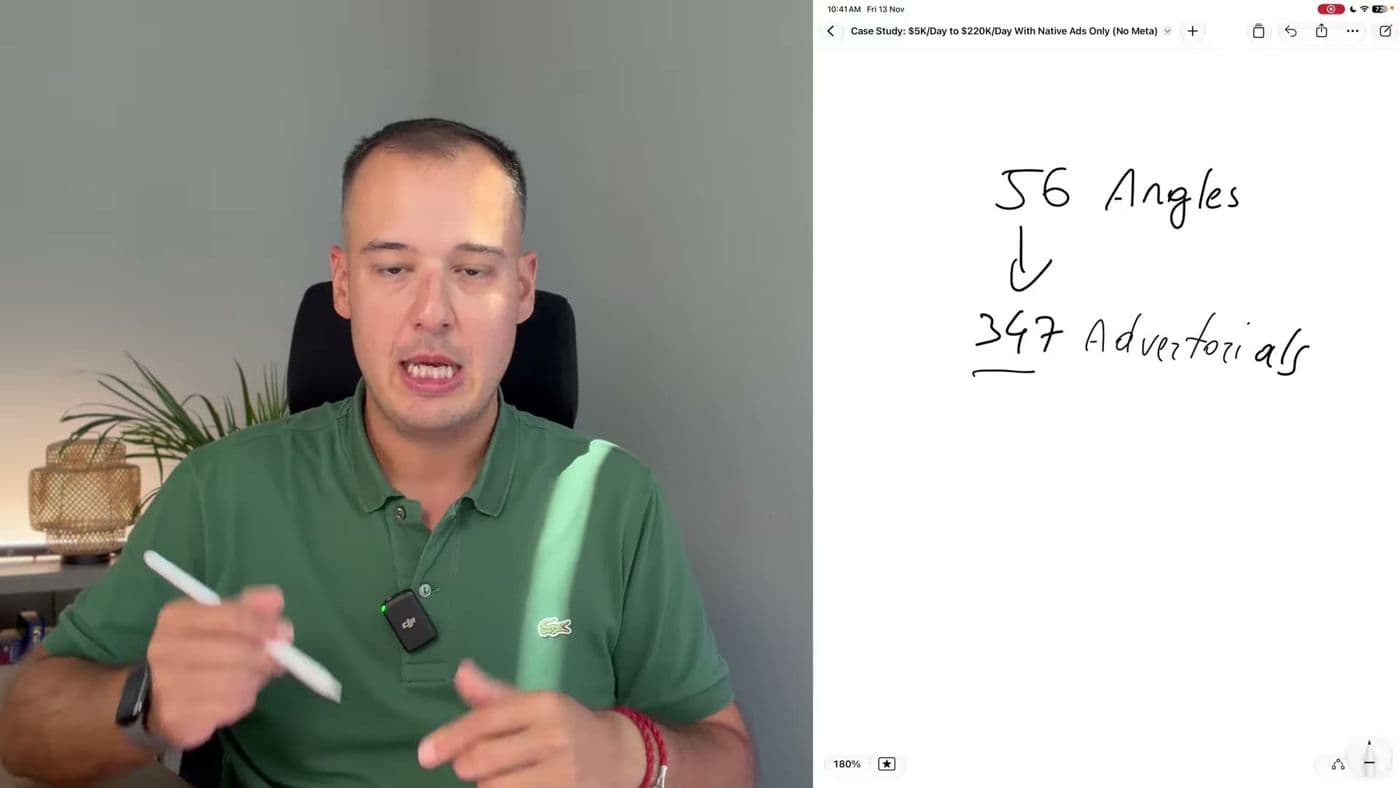
- Angles tested: 56
- Advertorials tested: 347
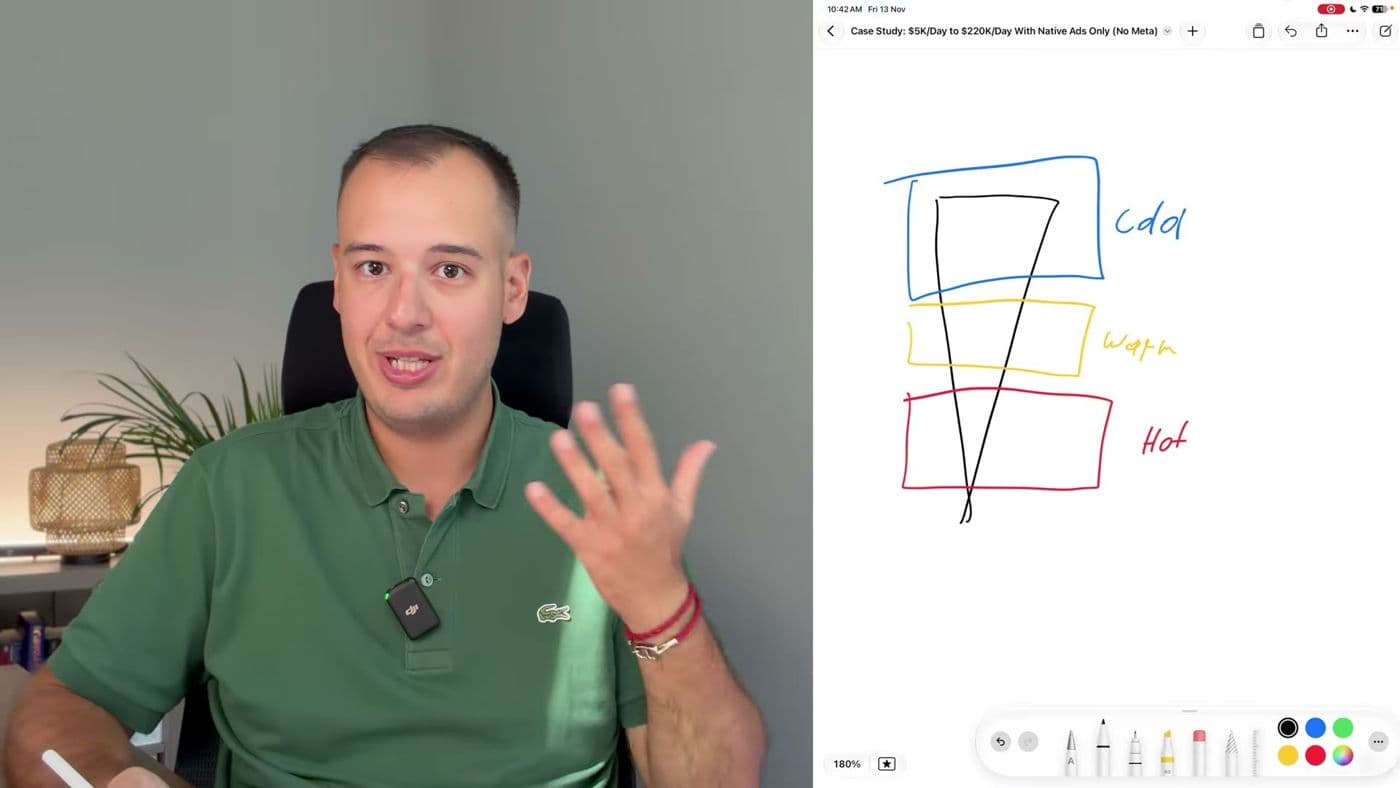
- Funnels: three, one per awareness stage (cold, warm, hot)
- Shown on screen: $3.11M in Shopify sales, last 30 days
The situation before
The brand sells skincare, one of the most crowded categories on social. On Meta it needed to be aggressive to be seen, and Meta kept pushing back. "Their ads got restricted, their ad account got restricted, their personal accounts got restricted," Marcel says in the video.
Even before the bans it was an on-and-off relationship. Some days were great, then a scale-up attempt would break everything at once. Return on ad spend was a constant fight. And because every live ad sits in Meta's Ad Library, competitors "basically just ripped off their ads." The brand always felt one step behind. In spring 2026 it was making about $5K a day.
What we built
One hero product. The store has five or six products. All traffic went to one of them. One product still has many buyer types behind it, so focusing did not mean running out of angles.
Angles, then lookalikes of the winner. The first round was three angles. The best one became the baseline, and the next tests were variations of it (2.1, 2.2, 2.3 in Marcel's whiteboard). Every new test either beats the baseline, matches it or loses. In the video Marcel uses plus 8 percent and minus 12 percent as examples of both directions and says this mixed picture is normal. These percentages illustrate the testing process; they are not reported results from this case. A test that beats the baseline becomes the new baseline.
Speed as the main lever. Marcel's argument: AI now writes advertorials and builds quiz funnels well enough to get most of the way there, so the brand that tests fastest wins. From May to November 2026 that meant 56 angles and 347 advertorials, each angle with its own headlines, ads, advertorials and funnel variants (quiz funnels, UGC funnels, AI and non-AI versions).

“Once Meta is trying to ban you, it's very hard to get back.”
Angles, advertorials and funnels
Native traffic is cold. Inside that cold traffic, people still sit at different levels of awareness, so the brand ran three funnel types:
- Hot. People who already know their problem (wrinkles, in Marcel's example) and already reject the obvious fix (Botox). Short funnel: show the results, show why the obvious fix is not for them, show what others say.
- Warm. People who have thought about the problem but never searched for a fix. The advertorial reactivates the problem, answers the questions and then pitches. Usually around 1,200 words.
- Cold. The clickbait-style story headlines you see on native. Marcel's example: a woman denied entry at the airport because her passport said she was born in '68 and she looked 30. Story opener, curiosity, a long editorial, a transition, the pitch at the end. The hardest funnel and the one with the least awareness.
Aggressive creative, handled on Taboola's terms. Headlines and images were aggressive, including before and after images. The team tried to get creatives pre-approved. When Taboola's content review rejected something, they read the reviewer's note, made the copy or image less extreme and re-uploaded. Marcel's historical observation, in his words: "if you upload like 20 ads, yes, they might reject like two to three, but they will not ban your account." That is his account of how rejections played out for this brand. This does not guarantee that repeated violations cannot lead to account restrictions: Taboola's help center states that an account that violates its policy multiple times may be deactivated permanently.
Could native work for your brand?
Check your fit · 60 secResults
What the Shopify dashboard in the video shows: one day at $221.9K in total sales from 1,233 orders, and the last 30 days at $3.11M from 17.4K orders, 714.4K sessions and a 2.33% conversion rate.
The video opens on the Shopify admin: $3.11M in sales for the last 30 days, recorded in November 2026, six months after the Taboola start. The video title refers to $200K days, which Marcel describes as the level this testing volume is built for.


What this proves and what it does not
What it shows:
- A brand that could not stay on Meta built a large sales month on Taboola as its paid channel.
- Testing volume was high: 56 angles and 347 advertorials in about six months.
- One hero product carried the whole build.
What it does not show:
- Ad spend, ROAS or profit. The video shows sales, not margin.
- How much of the $3.11M came from Taboola versus other channels. It is the Shopify total for the store.
- That your store gets the same numbers. This is one brand in one category.
Watch the case
[Embed: https://www.youtube.com/embed/0MBLT-jWTfA, title "$200K/Day With Taboola Ads: Full Case Study (No Meta)", 14:58]
Key moments
- 00:00 The case, brand name withheld to avoid copycats
- 00:38 Shopify dashboard: $3.11M in the last 30 days
- 01:24 Native as a scaling channel, and who this is for ($1K to $3K+ a day on Meta)
- 01:49 Same approach on Outbrain, or MGID, RevContent and NewsBreak combined
- 02:15 The brand: skincare, working together since May 2026
- 02:58 The problem: restricted ads, ad account and personal accounts on Meta
- 03:41 Competitors copying ads from the Ad Library
- 03:56 Start on Taboola with one hero product
- 04:40 Why speed is the biggest lever in 2026
- 05:28 Three angles, then lookalikes of the winner
- 05:58 How the baseline moves: plus 8 percent, minus 12 percent
- 06:57 May to November 2026: 56 angles
- 08:29 347 advertorials
- 09:11 Three awareness stages inside cold traffic
- 10:00 Hot traffic: the short funnel
- 10:43 Warm traffic: the 1,200-word advertorial
- 11:31 Cold traffic: the story funnel
- 12:44 Aggressive creative and Taboola rejections
- 13:42 Summary: testing and speed of implementation
- 13:55 Course or agency: what to do next
Full transcript of the video
*Lightly edited transcript of the video. Filler words and repeated words are removed, wording is otherwise Marcel's. Timestamps mark where each section starts.*
[00:00] In this video I have a $200K per day case study with Taboola ads for you. If you don't know me yet, my name is Marcel. We are in the middle of Q4. I founded one of the largest native advertising agencies and I run this YouTube channel. I will not mention the brand, I will just mention the category, because of course we want to avoid copycats. But I will take you a bit under the hood and show you exactly what we did when we started working together, so you can get an idea of what's possible with Taboola in 2026 and 2027.
[00:38] So here's a little proof. This is the Shopify dashboard. This is yesterday. Let's switch to the last 30 days. And you can see 3.11 million in the last 30 days. Again, if you don't know me yet, my name is Marcel. I founded one of the largest native advertising agencies out there. I've worked with brands like Kylie Cosmetics, Oura Ring, Revolve and many more, hundreds of D2C brands, under-the-radar dropshippers, and a lot of people I love to work with, who are my friends now. They are brands scaled up to enormous native advertising ad spends.
[01:12] This case study is not to brag. It's to show you what's possible with native, because native is a scaling channel. Native is there to scale up your brand. If you just want a bit of trial and error, if you're a young student with 200 bucks in your pocket, this is the absolute wrong video. This video is for you if you already spend 1K, 2K, 3K plus per day on, for example, Meta, on Facebook ads. Then this video can really open your horizon to what's possible with native ads.
[01:49] In this video we talk about Taboola specifically, because this is the traffic platform we are using for this brand at the moment. But this is applicable to native ads in general. You can get similar results on Outbrain, for example, or if you merge a few smaller native traffic sources together, like MGID, RevContent, NewsBreak.
[02:15] What was the problem back then? These are two brothers, and we have been working with them since May 2026. They have a skincare cosmetics brand. Skincare is a very competitive field, not just in general. There's a lot of retail and a lot going on in social ads, TikTok, Instagram ads. Now with AI UGC generators and AI content, people can create hundreds of new reels every day. So social media is a very competitive field. And even on native advertising you have a lot of competition in skincare and beauty.
[02:58] But their main issue, at the beginning of the year, in spring, was that their account got restricted over and over again. To be visible, they need to be more aggressive. So their ads got restricted, their ad account got restricted, their personal accounts got restricted. Everything went down in a miserable way. The problem is, once Meta is trying to ban you, it's very hard to get back. And even before, it was an on-and-off relationship. Sometimes it worked pretty well, there were great days, they tried to scale it up, and then all of a sudden everything broke down immediately. They always struggled with return on ad spend on Meta.
[03:41] And with the competition, everything is super transparent in the Ads Library. Their competitors basically just ripped off their ads and did something similar. That was their struggle. You always feel like you're behind and scaling is not really possible. So, long story short, they got restricted, and in May we started with Taboola.
[03:56] The brand has five or six products in the store, but instead of advertising all of them, we focused on one hero product. That's where we sent all the traffic. Even within this one hero product you have a lot of potential angles, a lot of audiences you can talk to. Take a very different product, say weight loss: you have people who want to get rid of belly fat, people who tried everything, people who don't want to try something like GLP-1. So you have a lot of potential audiences. If you look deeper into the product and do your research properly, you have a lot of potential.
[04:40] So we started to move fast. And to be honest, this is the biggest leverage you have right now in native advertising. Before 2026 it was: how good is your funnel, how good are your ads, how good are you at managing the ads. It was a bit like day trading. But now in 2026 you have AI. AI is everywhere. AI can make you quiz funnels. AI can write you advertorials. Yes, a professional advertorial copywriter with tons of experience might do it a bit better, let's say 20% better, but you can get 80% of the way with the right prompts and the right setup. So nowadays the biggest leverage is speed.
[05:28] What we did: we started quickly with three different angles. Angle one, angle two, angle three. Then we saw which angle gives us the best results. Let's say in this case it's angle two. So afterwards we created lookalikes and moved forward with that one: angle 2.1, 2.2, 2.3, because angle two was now our baseline. Once you have a baseline, you want to see whether a new test decreases the results, increases them, or stays on the same level. The main goal is to find what increases the results.
[06:19] But not every new approach increases it. Let's say this one gave plus 8% conversion rate, or 8% cheaper results. Then this is our new baseline. And it can also happen that with this one we lost 12%. This is very common. It's not about this case specifically, but it's very common to see this behavior. *(These percentages illustrate the testing process; they are not reported results from this case.)* Overall you get mixed growth and mixed decreases, and you always need to focus on what's winning. From there we moved forward.
[06:57] Skipping forward: now it's November 2026. We started in May 2026. Overall we had 56 approaches or angles, which is a lot, because every angle needs to be tested. Every angle contains a huge number of headlines, ads, advertorials, quiz funnels, different funnels: AI funnels, non-AI funnels, UGC funnels and so on. So there was a lot of work in the background. And this is what you see right now: testing is the winning thing, and the biggest leverage is speed, the speed of implementation. The faster you are, the faster you get results and the faster you see positive movement.
[07:51] Even though native advertising is slow. I like to compare native ads with a huge container ship of 350, 400 meters. It takes a while until the ship reaches 20 knots. But once it has that momentum, it's very hard to stop. Native ads are pretty much the same. But now, with AI and more and more competitors joining native, you have something like a thruster in the background. You have a positive push, a positive momentum, and it's up to you to use it in the best way possible.
[08:29] With these 56 angles, we ended up testing 347 advertorials. With every angle we do split testing, running different advertorials, but 347 advertorials. If you already run ads, compare that with your own. I'm pretty sure you're not there yet. If you don't want to scale like crazy, you don't need to go there, but this gives you an overview of what's necessary to get to $200K days. This is the way to go with Taboola ads.
[09:11] You might ask: how does this work with 56 angles? It sounds like a lot, and it is. Native traffic is always cold traffic, but you still have people at different stages of awareness. You have totally cold traffic, you have warm traffic, and you have hot traffic. The proportions in my drawing are not right, but you get the idea.
[10:00] Yes, native is always cold traffic, but within it you have people at different awareness stages. You have people who already know they have wrinkles, who need to solve the wrinkles, and who know Botox might not be the solution for them. You just need to give them a good solution and an alternative to Botox. These are the hot people. You need a much shorter funnel. For them it's more important to see the results and to see that Botox is not the solution. They have something they fight against, like Botox, and they want to see how it works and what other people say.
[10:43] Then you have warm people. They have thought about something already, but they were too lazy to look for a solution, too lazy to Google it. They're slightly hungry, but they need to smell the food to really get hungry. So in the advertorial you show them: this is the problem you have, you might not have been aware of it. You reactivate the awareness in their mind. That advertorial is a bit longer, usually around 1,200 words. You guide them through everything: you might already have noticed this problem, then you go through the stages, answer all the questions, and then you pitch the product. That's what you do with warm people.
[11:31] And you have cold people. That's the crazy ads you see on native. Like: "I went to the airport and the country denied my entry because my passport said I was born in '68, but I look like I'm 30." These are the crazy headlines for cold traffic. With cold traffic you need a very different approach: a story opener, a lot of curiosity, a lot of clickbait. You send these people to a very long editorial. You have the story, then the transition (why didn't they let you in, how did it happen?), and then the pitch somewhere at the end. This is the longest funnel and the most difficult one, for the stage with the least awareness.
[12:24] So you have three awareness stages. That's how you scale a brand on native: the traffic is cold, but there are three awareness stages, like everywhere in marketing. Hot, warm and cold.
[12:44] And in the end it's all about very aggressive native ads. The headlines, the images: we used very aggressive material, before and after images, or we tried to get everything pre-approved to avoid rejections. Even if you get a rejection from Taboola's content team, it's part of the game. It doesn't affect the account. That's the positive thing. On Meta, if you get rejected a couple of times, it might affect your account quality. On Taboola, that basically never happened. If you upload 20 ads, they might reject two or three, but they will not ban your account. *(Marcel's historical observation. This does not guarantee that repeated violations cannot lead to account restrictions; see Taboola's account deactivation article under Sources.)* You see what the content review team writes, you adapt it, rewrite it, create an image that's less gross, less extreme, re-upload it, and it works. That's the basic process. So if you struggle with rejections on Meta, if your approach is too aggressive for it, if you work a lot with before and after, then Taboola or native ads in general might be the way to go.
[13:42] Let me summarize. Testing and speed of implementation are the leverage of native advertising right now. That's the thing you can do quickly and implement yourself. If you want to do this yourself, check out my course at native-ads-course.com, where we show you all the prompts you need and exactly how to start. And if you want to work with me, go to native-advertising.net and see if you're eligible. It's a simple process: we check your brand and see if it's a good fit for native. If not, we tell you. If yes, we hop on a call.
[14:25] So you have three options. Option one: close this video and go doom-scroll on TikTok or Instagram. Option two: if you want to implement it yourself, take the course and invest in your knowledge. Option three: work with me. Just go to native-advertising.net. Whatever you decide, I wish you a great Q4, a lot of success and a very high return on ad spend. See you next time.
Is your brand next?
This brand had a product people wanted and a channel that kept shutting it out. If you sell e-commerce at an AOV of $60 or higher, already spend about $1k a day or more on Meta and are profitable there, the fit check takes 60 seconds. Accounts, pixels and advertorials stay in your name from day one, and you talk to Marcel directly.
Links: Case 02: stuck at $2.3M on Meta · All case studies · Taboola agency · Taboola vs Outbrain · Native ads vs Meta ads
Frequently asked questions
Can Taboola work if my Meta ad account was banned?
It worked for this brand. After repeated restrictions on Meta, it moved its paid traffic to Taboola in May 2026 and reached $3.11M in Shopify sales over 30 days by November. Taboola has its own advertising policies and its own review, so the offer and claims still have to pass. A Meta ban says nothing about Taboola either way.
How many angles do you need to scale on Taboola?
There is no fixed number. This brand started with three angles and kept going until 56 angles and 347 advertorials over six months. Marcel's point in the video is that you only need that volume if you want to scale hard. Smaller brands start with a few angles and build on the winner.
Why only one hero product?
We concentrated traffic on one hero product and tested different angles for it. The store has five or six products, but one product still has many buyer types behind it, and each buyer type is an angle. Every winning test then became the baseline for the next round of variations on that same product.
How long should a native advertorial be?
It depends on the awareness stage. In this case, warm traffic got advertorials of about 1,200 words. Cold traffic got even longer story-led editorials with a transition before the pitch. Hot traffic got the shortest funnel, focused on results and proof.
Does a rejected ad hurt my Taboola account?
In Marcel's experience with this brand, rejections were part of the routine: some ads out of a batch were rejected, the team read the reviewer's note, toned the creative down and re-uploaded. That is his account of this case, not a guarantee. Taboola's help center states that repeated policy violations may lead to permanent account deactivation, so read the policies before you launch aggressive creative.
Meta is capped. Add native next to it.
Three questions, 60 seconds. Good fit? You pick a 60-minute call with Marcel on the spot.