From $2.3M to $3.4M a month in 90 days, with Taboola added next to Meta
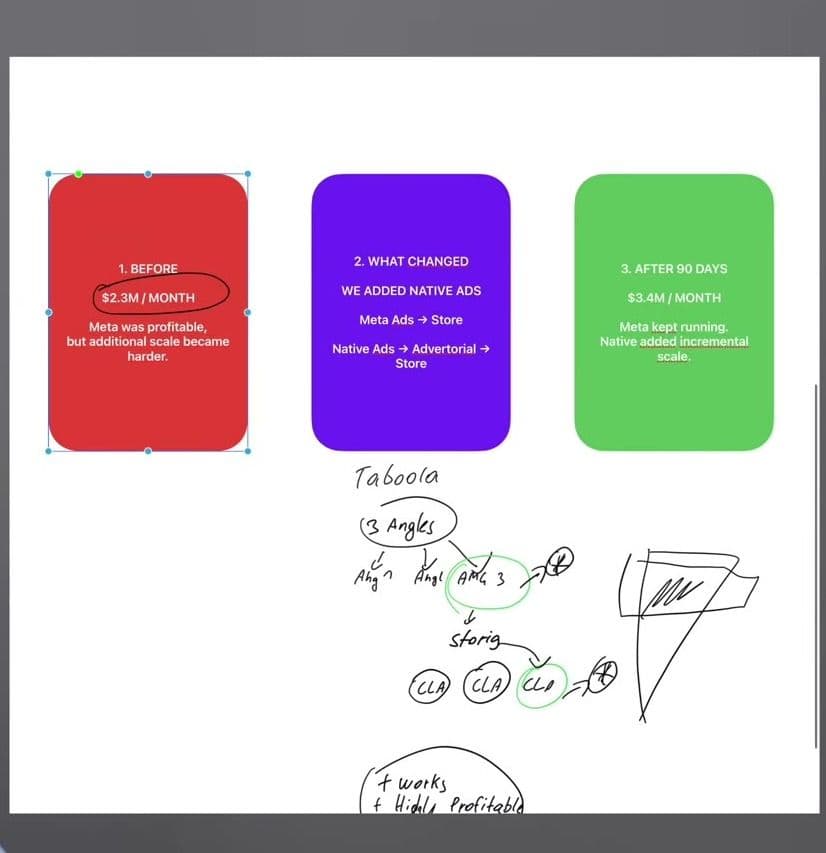
This store was profitable on Meta and could not grow past $2.3M without ROAS falling apart. We left Meta running and added Taboola as a second channel. Within 90 days monthly Shopify revenue went from $2.3M to $3.4M.
- Category: shapewear, evergreen product
- Timing: middle of the year, no seasonal peak
- Meta: kept running the whole time
- Build: 3 angles x 3 advertorials
- Winner found: in under two weeks
- Monthly Shopify revenue: $2.3M before, $3.4M 90 days later (Marcel's slide in the video)
The situation before
Meta was working. That matters for everything that follows. The store was profitable on Meta and still could not get past $2.3M. "Always when they tried to increase their ad spend, their return on ad spend, their ROAS dropped, and they were sliding into unprofitability," Marcel says in the video.
They had already tried the usual fixes: other agencies, outside experts, working with Meta directly. None of it moved the ceiling. The problem was not the Meta account. The store had used up what that one channel could profitably buy.
What we built
We did not try to fix the Meta account. We added a layer next to it: Taboola sending readers to advertorials, and the advertorials sending buyers to the same store.
The product. Shapewear, an evergreen product. The test ran in the middle of the year, with no Christmas or seasonal tailwind behind it.
The test grid. Three angles, three advertorials per angle, and each advertorial in a different format:
- Newspaper-style editorial. Reads like an article on a news site.
- First-person blog story. Marcel's example: "Hey, my name is Marie Anne, I'm 65 years old. I tried dieting, but then I figured out there is shapewear."
- Listicle. Marcel's example: "Seven things no star will tell you about how they dress."
Accelerated budget. The client wanted results fast, so the test ran with accelerated budget to get to a readable answer sooner.

“If you're scaling your e-commerce offer on Meta, sooner or later you're gonna hit an invisible ceiling.”
The winning angle
Angle three won: the celebrity angle, built on the idea that most stars wear shapewear underneath. Marcel describes it as "a very, very good story," with celebrity endorsements used inside the advertorials.
Why it worked, in his reading: native is top of funnel. The reader on a news site is not shopping for shapewear and has no idea they want it. They need a story that explains why. They are already in reading mode, so the advertorial gives them more to read.
Once angle three was clear, the next round was lookalikes of the winning advertorial, with the winner as the baseline. One lookalike beat all the others and became the new winner. All of that happened in under two weeks. Because the angle was broad and top of funnel, it had room to scale, and budget went into it from there.
Could native work for your brand?
Check your fit · 60 secResults
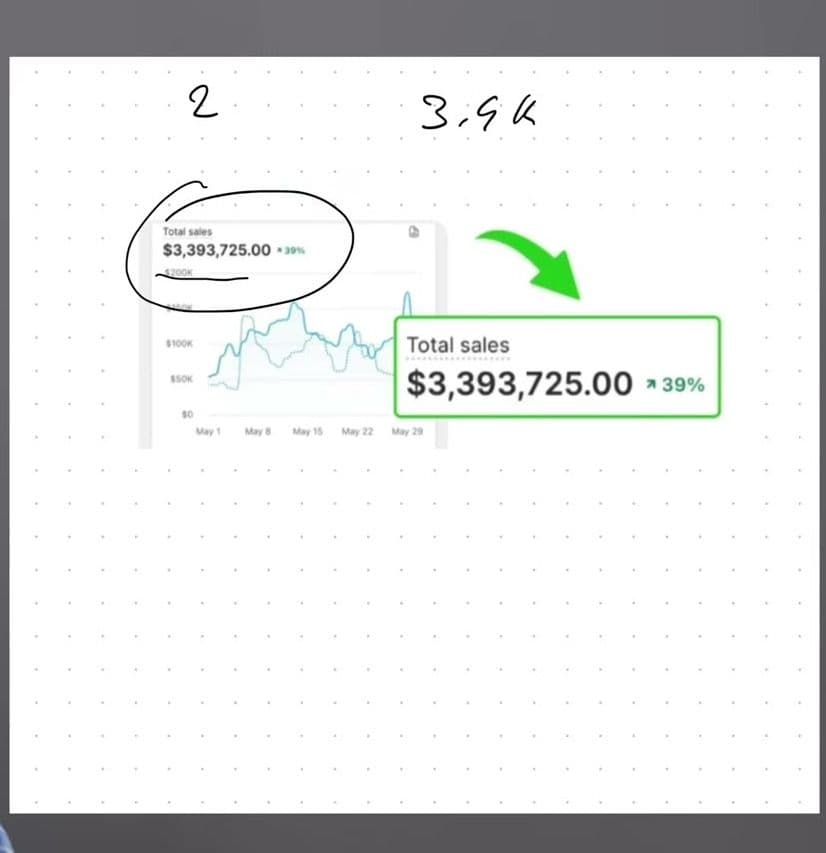
Monthly Shopify revenue went from $2.3M to $3.4M within 90 days, about $1.1M more per month. Meta kept running the whole time. Native was added as the scaling channel.
What this proves and what it does not
What it shows:
- A store that was profitable on Meta added a second paid channel while Meta kept running, and its monthly Shopify revenue moved from $2.3M to $3.4M.
- A small, structured test (three angles, nine advertorials) found a winner in under two weeks for this offer.
- A broad, story-led angle scaled further than a narrow one.
What it does not show:
- Spend, ROAS or profit on Taboola. The figures are total Shopify sales for the store.
- How much of the sales Taboola drove versus Meta or other channels.
- That this speed is typical. Marcel calls it a highlight and "not a very normal scenario." Some stores take longer, for example because less cash flow limits how fast spend can grow.
Where native hits its own ceiling
Native has a ceiling too. In the video Marcel puts it this way: "If you spend way more than 8k to 9k per day on Taboola, I always recommend adding another traffic source, for example Outbrain, to scale to around 15k, 16k." Past that, he says, when a single placement performs well, a brand can approach that publisher directly and book slots on a CPM basis. That is Marcel's experience from his own accounts in this video, not a platform limit and not a threshold for your store. The general rule: add another network when the first is profitable and further budget increases stop paying.
Watch the case
[Embed: https://www.youtube.com/embed/ykUNgqjZ-Lk, title "Meta Was Profitable And Stuck At $2.3M. 90 Days Later: $3.4M With Taboola Ads for E-Commerce Brands", 10:46]
Key moments
- 00:00 The invisible ceiling on Meta
- 00:13 Why the answer is a second channel
- 00:44 The store before and after: $2.3M and $3.4M
- 01:04 Ninety days, exactly
- 01:14 They had already tried everything
- 01:30 Meta was profitable, and that is the point
- 01:43 What we added and where it sits
- 02:01 Evergreen product, ordinary time of year
- 02:20 Three angles, three advertorials per angle
- 02:34 Newspaper, blog, listicle
- 03:05 The fast route: accelerated budget
- 03:27 Angle three won: the star angle
- 03:51 Native is top of funnel, the reader is unaware
- 04:18 Lookalikes of the winner
- 04:44 Scaling once something works
- 05:21 The numbers after 90 days
- 05:50 Meta kept running the whole time
- 06:10 Profitable on Meta means the offer already works
- 08:47 Back to the case
- 08:56 The fast end, not the normal one
- 09:20 Native has a ceiling too
- 09:33 Adding Outbrain at $8k to $9k a day
- 09:38 Booking a placement direct
Full transcript of the video
*Lightly edited transcript of the video. Filler words and repeated words are removed, wording is otherwise Marcel's. The section from 06:40 to 08:47, about a course that was still being recorded at the time, is shortened to one line because it is out of date.*
[00:00] If you're scaling your e-commerce offer on Meta right now, sooner or later you're going to hit an invisible ceiling. Once you hit it, that's the threshold where you can't go further with the same profitability on Meta. That means you need to switch the channel. Today I have an example for you of a shapewear brand that went through this process successfully.
[00:22] If you don't know me yet, my name is Marcel. I've spent more than 100 million US dollars in profitable ad spend on native advertising traffic sources like Taboola, Outbrain, NewsBreak and many more. I used to run one of the largest native advertising agencies out there, and I have this YouTube channel. Feel free to subscribe to get an update when I upload a new video about native ads. Now let's jump into the case study.
[00:47] This Shopify store had, after working with us, 3.4 million US dollars. Ninety days before, it was 2.3 million US dollars. In between are exactly 90 days. What we did, basically, is add a new layer in between. This store had tried everything. They worked with agencies, with experts, with Meta itself, and they couldn't scale above this. Then they worked with us. Here's an overview.
[01:26] Before, as I said, they had 2.3 million. Meta was very profitable, by the way. But they couldn't scale further. Whenever they tried to increase their ad spend, their return on ad spend dropped and they slid into unprofitability. So we jumped in and added native ads. In this case, we added Taboola. Instead of just Meta to the store, we added a whole new layer of Taboola.
[02:01] Again, it's body shaping, an evergreen product. It was the middle of the year, so neither Christmas nor a special season. Right now, for example, this kind of store can make a ton of money in December and January, getting the shape you want, ball season and so on. But this was randomly in the middle of the year.
[02:20] What we did: we created three different angles. Every angle had three advertorials, and every advertorial was different. One advertorial was an editorial, like a newspaper article. Another was a blog article, like: "Hey, my name is Marie Anne, I'm 65 years old. I tried dieting, but then I figured out that there is shapewear." And then, for example, "The seven things no star will tell you about how they dress when they wear a nice dress," something like that. And we had these three different angles.
[03:02] Let me draw this differently so it's easier to understand. This client wanted results fast. Angle one, angle two, angle three. With accelerated budget we quickly found out which one was the winner. Advertorial three was the winner: the star angle. The majority of stars wear shapewear underneath. We had a very good story with this, and a few star endorsements that we used in the advertorials.
[03:44] People jumped into this topic because many of them were totally unaware. And this is the beautiful stage when it comes to native ads, because native is top of the funnel. People are in the total stage of unawareness. So they need a story: why to buy this product, what's the background. So we delivered stories to read. People were already in reading mode, so we gave them more stories to read.
[04:15] Once we figured out which angle works, we created lookalikes of the advertorials, because this one was our baseline. We created different lookalikes, found that one lookalike works way better than all the others, and that became our winning angle. On this winning angle we scaled up quickly, because within less than two weeks we had something that was working. It was highly profitable. And since it was very top of the funnel, a very broad approach, it was highly scalable. That's how we moved forward.
[05:21] Let me show you what changed. After 90 days: this store had 2.3 million at the beginning. Within just 90 days, a very short period, just three months, we scaled up by more than one million US dollars, which is a very nice number. We basically added 1.2 million within 90 days. Meta kept running. We just added native as a scaling channel.
[05:55] This is the best case scenario, by the way. I've had many similar examples with a lot of brands and a lot of dropshippers. They were super profitable and successful on Meta. For me that always means the offer works. You don't need to talk to them about fulfillment issues or payment processor issues. You don't need to figure out the basics. These people usually figured all that out along the way: which offer works, the AOV, how to increase the AOV. They know all of this. They just want to scale harder. And that's exactly the situation where native makes sense.
[06:40] *[Shortened: Marcel talks about the native ads course he was recording at the time. The course is now available at native-ads-course.com.]*
[08:47] Back to the topic. This client scaled up by about 1,200,000 within 90 days. Yes, it's a highlight. It's not a very normal scenario. Some stores take a bit longer, because they may have less liquidity, less cash flow, which is totally fine. But I've had definitely more than 150 or 200 clients with the same kind of timeline, the same increase in ad spend.
[09:20] Of course there's another ceiling when it comes to native. For example, if you spend way more than 8k to 9k per day on Taboola, I always recommend adding another traffic source, for example Outbrain, to scale to around 15k, 16k. You can stretch this. And at some point, if you see that a placement works really well, you can reach out to the placement directly and book slots, so you don't need to go through the reseller in between, which is usually Taboola or Outbrain. What they do is basically arbitrage: they bought these placements, or the rights to them, and they sell them to you.
[10:00] So if you see that one placement is a high-performing placement, reach out to them directly and book a placement with them. It usually works a bit differently: it's a CPM-based pricing model. It's a bit more complicated and not as transparent as Taboola or Outbrain. But you can scale more easily, and much more predictably, because it's a simple CPM booking.
[10:28] Those are my three cents on scaling through native ads with Taboola. Let me know in the comments what ceiling you hit with Meta, if you've already reached one. If you have any questions, let's meet in the comments. Thanks for watching. Have a good one.
Your store at the ceiling?
This store had what native needs: profitable on Meta, an offer that already sold, an AOV the funnel could pay for. If you spend about $1k a day or more on Meta, sell e-commerce at $60 AOV or higher and keep hitting the same wall, the fit check takes 60 seconds. The kill rule is agreed in writing before launch, and Meta keeps running while we test.
Links: Case 01: $3.11M in 30 days on Taboola · All case studies · Native ads vs Meta ads · Taboola agency · Taboola vs Outbrain
Frequently asked questions
Why does ROAS drop when I scale Meta ads?
In this case it happened every time the store raised budget: Meta was profitable at the current level and slid into unprofitability above it. More budget on one channel means reaching people who are less likely to buy. Adding a second channel with a different audience is one way past that, and it is what this store did.
Do I have to turn off Meta to test native ads?
No. In this case Meta kept running the whole 90 days. Taboola was added next to it, with its own advertorials sending traffic to the same store. Keeping Meta live protects the revenue you already have while native proves itself or does not.
How fast can you find a winning angle on Taboola?
For this store, under two weeks, using accelerated budget on three angles with three advertorials each. Marcel is clear that this is the fast end. Other stores take longer, and our standard plan gives testing weeks 3 to 5 after a two-week build.
What kind of advertorials work for shapewear?
In this test, three formats per angle: a newspaper-style editorial, a first-person blog story and a listicle. The winning angle was the celebrity angle, built on the idea that most stars wear shapewear underneath. Whether that carries over to another brand is something only a test can tell you.
When should I add Outbrain next to Taboola?
Add another network when the first is profitable and further budget increases stop paying. In this video Marcel describes his own experience: "If you spend way more than 8k to 9k per day on Taboola, I always recommend adding another traffic source, for example Outbrain." That is his account history, not a threshold every store has to reach first.
Meta is capped. Add native next to it.
Three questions, 60 seconds. Good fit? You pick a 60-minute call with Marcel on the spot.